Michael Durant
Black Hawk DownMichael Durant is the injured pilot captured after his Black Hawk helicopter went down in Mogadishu, and the sole member of its four-man crew and two Commando defenders to return. His captivity unfolds through successive reversals: a rescue column passes close without reaching him, his captors shoot him, and responsibility for his safety shifts between armed groups. His eventual release is both a personal survival and a stark measure of the battle’s losses.
Identity and Capture
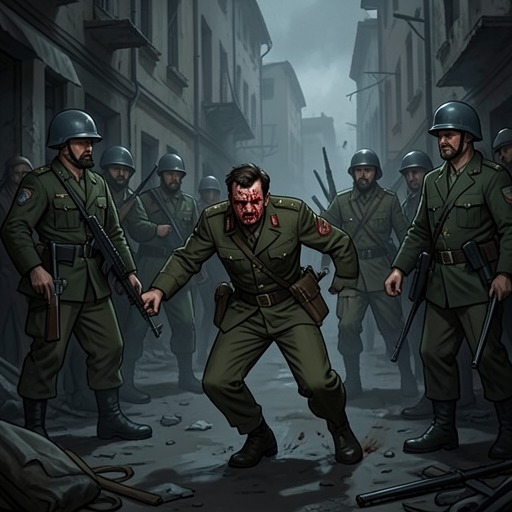
Durant was a Black Hawk helicopter pilot whose aircraft was brought down during the fighting in Mogadishu. On the evening of the crash, an angry crowd overran the crew and the two Commando sergeants who had fought to protect them. Durant was carried off; the others were dead, though he did not know that as his captivity began. He had passed out while being taken away and remembered feeling as if he were watching events from outside his own body, a brief detachment that calmed him before the ordeal continued.
The first captor to spare him was Yousuf Dahir Mo'Alim, a neighborhood militia leader who had protected Durant from the attacking crowd. Mo'Alim and his men intended to carry the pilot back to their village and contact leaders of the Habr Gidir clan. Durant could not walk, so they carried him. Their plan was interrupted by a Land Cruiser with a mounted gun, driven by freelance street fighters who belonged to no clan. Unlike men who might have treated Durant as a prisoner to exchange for captured Habr Gidir leaders, these bandits saw an injured American whom someone might pay to recover. Outnumbered and outgunned, Mo'Alim’s men handed him over. In the city’s prevailing balance of force, the bandits’ greater firepower decided who controlled the captive; if Mohamed Farrah Aidid wanted Durant back, he would have to pay.
The Captive in the Room
Durant was driven around in the back of a flatbed truck, his head covered with a rag. The vehicle repeatedly started and stopped. He guessed that about three hours after the crash he was brought to a small, windowless, octagonal room, where the rag was removed and he was chained. The bare room had one closed door and no furniture. Air, light, and sound entered through cross-shaped openings cut into the concrete walls. Birds sang and children played nearby; the sunlight and ordinary sounds seemed sharply at odds with the violence that had brought him there. They made him wonder whether the building was a garden house or perhaps near an orphanage he knew existed in northern Mogadishu.
He lay on a cool tile floor, frightened, thirsty, and unable to tell where in the city he was. His right femur was broken, and the bone had pierced his flesh during the rough handling. He could feel blood inside his pants. He reasoned that the bone had not severed an artery because he was still alive, but did not know whether the comparatively limited pain was reassuring. His back troubled him more: he suspected a crushed vertebra from the crash, though he could not establish the injury. Bound with a metal dog chain looped around his hands and across his stomach, he spent the night trying to make himself more comfortable.
Sweat eventually let him slide one hand free of the chain. The small escape gave him a first sense of triumph: he could wipe dirt from his nose and eyes and straighten his broken leg somewhat. He then put his hand back in the chain so his captors would not discover what he had done. The gesture was modest, but it gave him a little control inside a situation otherwise governed by injury and other men’s weapons.
A Near Rescue and a New Wound
During the night, Durant heard the guns of the enormous rescue column as it fought its way into the city. Several armored personnel carriers rolled past outside; gunfire erupted nearby. He feared he was about to be rescued or killed. The fighting’s proximity raised his hope, but the sounds moved away and faded. Their departure left him feeling abject: the rescuers had been so close, yet had not reached him. At dawn, birdsong and children’s voices offered a brief counterweight to the fear, and he felt safer than at any point since the crowd had closed around him.
That reprieve ended when a gun barrel appeared around the door and fired. The bullet struck the floor before ricocheting into Durant’s left shoulder; a piece of shrapnel entered his left leg. He could see the back end of the round protruding from his shoulder, without having fully penetrated. Acting reflexively, he slipped his hand free of the chain and tried to pull it out. The bullet was still hot enough to burn his fingertips. He learned to wait for it to cool, while remaining injured, chained, and in the hands of his captors.
Captivity, Transfer, and Release
On his first day in captivity, still on the tile floor with his broken right leg and newly wounded shoulder, Durant’s captors asked him to make a video. He refused. He was surprised they had asked, since he believed they could make a video regardless, but considered it safer not to speak to the world from that position. His refusal was a limited decision made under coercion: he could not control the circumstances of his captivity, but he declined to participate willingly in its public presentation.
On the second night, Durant was brought to Abdullahi Hassan, known as Firimbi, Mohamed Farrah Aidid’s propaganda minister. Aidid’s men had bought Durant back from the bandits, and Firimbi was assigned to keep him safe. He was explicitly warned that any harm to the pilot would be done to him in turn. Durant’s custody had thus shifted again: he was no longer held by the freelance fighters who had taken him from Mo'Alim’s men, but his safety remained a matter of armed power and responsibility imposed on another man.
As the American effort to recover Durant threatened further fighting, Robert Oakley delivered a warning to Mohamed Farrah Aidid’s representatives: a rescue attempt would bring renewed combat, and the resulting destruction would extend beyond combatants to the people and animals of the city. The representatives conveyed the message and what Oakley called friendly advice to Aidid, who offered to hand Durant over. Oakley asked for a delay of a few hours to allow him to leave the country, directed that Durant be turned over to Paul Howe, and then flew back to Washington. Durant’s release came amid the effort to avert another round of fighting, not as a return to an intact crew or an uncomplicated victory.
On the day he was released, men from Task Force Ranger and others based at the hangar assembled to salute him. Durant was carried on a litter through hundreds of men in desert fatigues, an IV in his arm and his unit’s red beret in his grasp. The scene held joy and enormous relief, but also grief: he alone had returned from the four-man crew and the two Commando defenders. The battle had killed 18 Americans and wounded 73; more than 500 Somalis were dead and at least a thousand injured. Durant’s survival therefore marked both the recovery of a captive and the absence of the men who had shared his aircraft and defended its crew.